

What I went to find out
Before I left for Yerevan, I wrote that Great Yellow was heading to COP17 with a specific agenda: not to advocate for nature markets in the abstract, but to test our thesis against the most important buyers, investors, and policymakers in the world. We wanted to understand whether the model we are building in the UK (stacking revenues to make Landscape Recovery investable) is translatable, scalable, and credible to an international audience.
We were also watching for signals on policy. The UK Emissions Trading Scheme's (ETS) potential inclusion of nature-based carbon removals has been on the agenda for some time, and the Kunming-Montreal Global Biodiversity Framework's first stocktake was due to deliver a clear picture of whether governments are on track. Finally, we wanted to understand where institutional capital is moving and what it still needs to commit.
Steve Kellett, our Head of Corporate Partnerships, and I attended as part of the UK Business and Biodiversity Forum delegation. A packed out visit of panels, roundtables, corridor conversations, and late-evening debriefs later, here is what we learned.
What the global conversation told us
The real bottleneck is demand, not capital
This was said in almost every finance-focused session we attended and it was said by investors, not just project developers. The consensus at COP17's Finance Day October was unambiguous: there is capital available for well-structured nature projects but what is missing is creditworthy, structured demand for nature outcomes.
Whilst not new information, that matters for Great Yellow because it is exactly how we have framed our work for the past three years. The constraint is not finding landowners willing to restore habitats, or finding investors willing to back them but the ability to find buyers who will sign long-term contracts for nature outcomes that are independently verified and commercially structured, to give investors confidence of project revenue. Hearing this confirmed at COP17 by institutional investors speaking openly gave me a lot of confidence that we’re chipping away at the right challenge.
Disclosure is accelerating corporate action
The growing interoperability between the Taskforce on Nature-related Financial Disclosures (TNFD) and the International Sustainability Standards Board (ISSB) standards is having a real effect on how corporates approach understanding their own exposure to environmental degradation. More companies are beginning to map their nature dependencies and risks and when they do, water almost always comes out as the most material exposure. For food and agriculture businesses, water quality and availability is an operational risk whilst for infrastructure operators, it is a physical risk. Corporate disclosure is slowly turning what was once a voluntary conversation into a procurement activity to protect supply chains and fixed assets.
The UK model is ahead (in some ways)
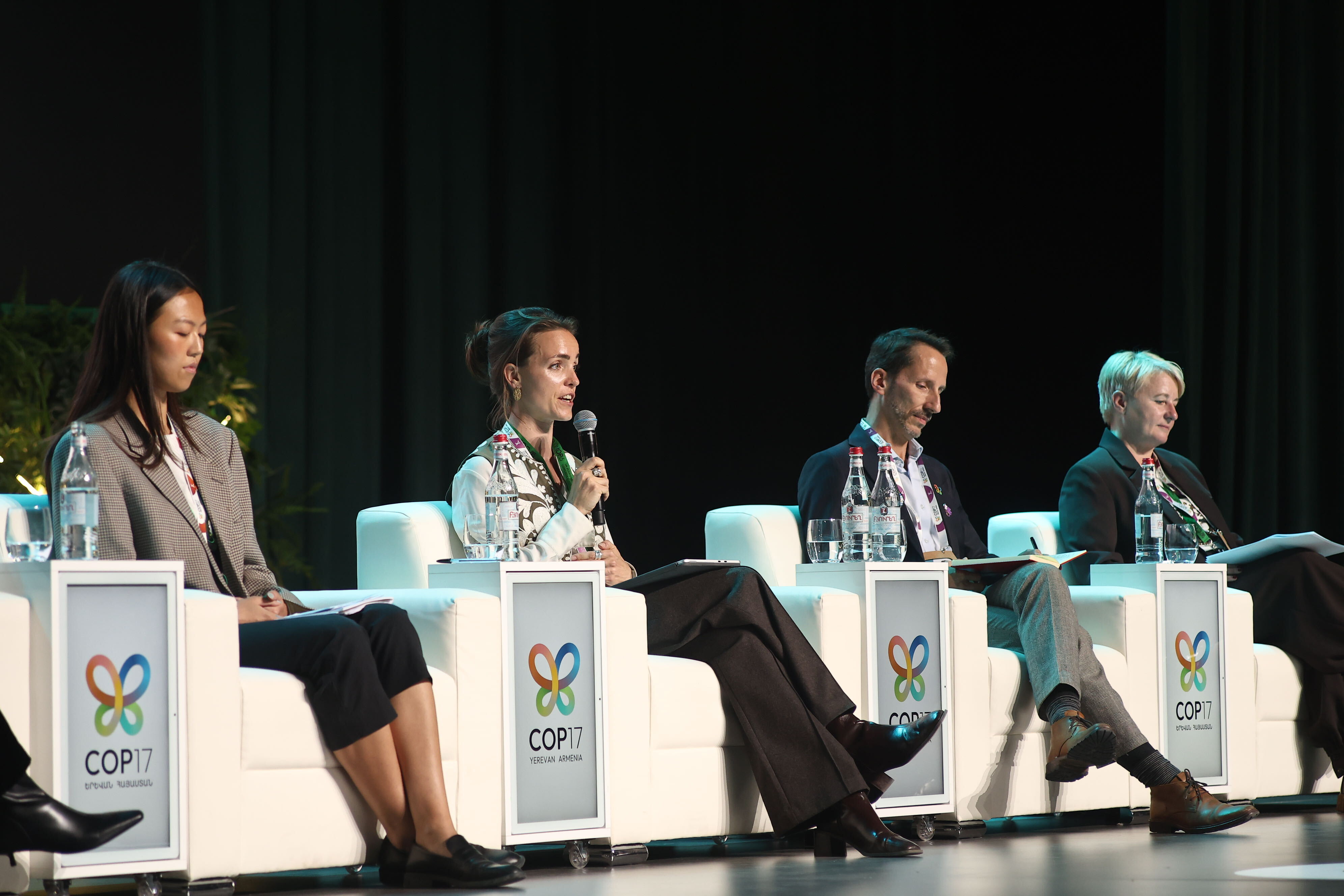
Multiple conversations pointed to the UK as a rare example of a jurisdiction where regulatory demand for nature outcomes already exists and where the policy architecture is sophisticated enough to attract private capital. Schemes like Biodiversity Net Gain (BNG), the Water Industry National Environment Programme (WINEP), the Environmental Land Management schemes (ELMs), and Landscape Recovery are not perfect, but they are real mechanisms that are helping to build the market – BNG creates a credit market whilst WINEP and ELMs Landscape Recovery provide the regulatory and grant foundations that make private investment viable alongside it. When I explained Great Yellow's model and work on Catchment Investment Plans and Landscape Recovery projects at the UNGC Green Zone panel, the response was consistently: "We want to understand how you did that."
The gap is that the UK has not yet exported this model because whilst the architecture exists domestically, the pipeline of well-structured, investor-ready nature programmes is still thin. That is the work Great Yellow is doing to move beyond just delivering nature outcomes, to proving the model is replicable.
It’s important to note that the UK is uniquely positioned to deliver these programmes because of the way that our agricultural and environmental policy has been developed, and the regulatory parameters (both financial and environmental) that our financial institutions, utilities and infrastructure entities operated within.
That creates both a responsibility to demonstrate that the UK model works, and an opportunity to position it as a template for markets that are two to three years behind where the UK is now. It’s impossible to ignore the updates that landed whilst we were away, including the Autumn Budget and Growing Places Policy Paper which show us how fluid these policy environments are. If we’re to prove these models domestically and export them globally, we need these political headwinds to die down somewhat. Deploying these models presents a new challenge in itself and not something that we should be naive to assume will be advocated for as much as we might think – yet.
We must not lose sight of fair compensation and support for land stewards
I joined a panel hosted by the UN Global Compact Network which opened with a seven-minute film from Indigenous communities in Colombia. This was a reminder that what we call "nature markets" are, at their core, about restoring relationships between people and land that were broken a long time ago, and ensuring that the financials are in place to secure them.
My brief was the farmer and finance perspective, grounded in learnings from UK Landscape Recovery projects and water company Catchment Investment Plans. The question posed to me was: are we spending too much time convincing farmers to care about nature, when the real opportunity is to make the nature-positive choice the better business decision?
My answer was structured around what needs to be in place for nature positive as the better business decision to be true at scale:
- Shift from relying solely on public subsidy to incorporating private markets: existing UK agri-environment schemes reward farmers for adopting more regenerative practices. This is necessary but not sufficient because it does not scale without the market infrastructure that brings buyers, generates revenue and draws in private finance alongside it.
- Cover the transition risk using blended finance: Defra’s Landscape Recovery Scheme combines grant payments and first-loss capital with private finance. This is how Great Yellow structures investment into projects like the Evenlode Landscape Recovery project: fund the transition window with public funding, then draw down institutional debt and equity as cash flows demonstrate demand for BNG, carbon and water outcomes.
- Stack multiple revenue streams: by combining BNG credits, water quality payments, carbon, natural flood management, and regen ag payments, farmers can access diverse and more predictable income. This gives investors the portfolio diversification they need and it gives buyers a structured procurement exercise rather than a pledge.
The panel confirmed that the gap between global ambition and funded delivery is primarily one of structure, not intent. Institutional investors like Ming Yang from Federated Hermes want to invest but they need 10 to 15 years of demonstrated cash flow before committing at scale. That is the market we are collectively building in the UK right now.
My favourite moment was the provocation: name a commercial opportunity that secretly unlocks nature outcomes. I chose water because the nature finance conversation, in my experience, loses corporate audiences when it leads with biodiversity targets, GBF commitments, and ecosystem services frameworks. These matter enormously but they are difficult to quantify and translate into demand from project data, and crucially are not the language of a water company's capital programme, or a rail infrastructure team assessing flood risk on the network – but water risk is. Flooding, water quality reduction and catchment degradation are balance sheet issues which cost-benefit analyses of nature-based interventions vs. grey infrastructure are increasingly showing to be bankable.
What Great Yellow are doing is directly aligned to what the sector is seeing
Steve joined Tom Butterworth from Arup, Emma Toovey from Environment Bank, Tayfun Bahsi from 17S Transition Finance Advisory, Meryl Wingfield from British International Investment, and Kiran Sehra from Aviva at a UK Business and Biodiversity Forum panel here in Yerevan. The session asked how businesses can turn pledges into practical action that supports delivery of the Kunming-Montreal Global Biodiversity Framework.
The panel landed on something we know well: demand is the limiting factor and not capital, or project supply. It was validating for us to hear agreement from the panel that projects cannot be built speculatively but they need to be shaped around it from the start.
Three points Steve raised echo Great Yellow’s approach:
- A portfolio of revenue streams across carbon, biodiversity net gain, and water gives investors the confidence to commit.
- Water outcomes from nature-based solutions are becoming investable, but corporates need business cases built on avoided costs and reduced risk, not conventional return on investment.
- And allowing nature-based carbon removals into the UK Emissions Trading Scheme would be a step change for the market.
That last point connects international ambition directly to domestic policy. Forums like COP create frameworks that set direction. ETS reform is necessary for expanding the demand that determines whether projects can actually be financed.
What we took into these sessions as what we’re delivering and the insights we’re gathering through our work with UK Landscape Recovery projects was reflected back to us as what is required to unlock finance for nature recovery at scale. COP was the ideal forum for testing these assumptions and strengthening our connections with the partners and collaborators who can help us to accelerate those efforts.
What the negotiations actually produced
COP17 concluded on 31 October 2026, adopting around 50 decisions. Unlike COP16 in Cali, which ran out of time and required a resumed session in Rome in February 2025, Yerevan got over the line. That itself is worth noting.
The headline output was the Yerevan Pathway: a political agreement to accelerate implementation of the Kunming-Montreal Global Biodiversity Framework ahead of the 2030 deadline which is directional, but not binding. The first formal GBF stocktake was completed, confirming clearly that the world is not on track for 2030.
On finance, the gap between aspiration and commitment was stark: around $2 billion in voluntary nature pledges was mobilised during the conference but the annual finance gap stands at $700 billion and no binding mechanism for developed countries to meet Target 19 was agreed. Big pharma lobbied hard to weaken contribution rules; whether the final text holds up against that pressure will become clearer in implementation.
What was not agreed were the binding finance commitments, meaningful reform of harmful subsidies, ocean protection, and any compulsory upward ratchet on national ambition.
This matters for UK nature markets. The persistent failure of international finance mechanisms to mobilise at scale makes the case for private procurement and blended finance instruments stronger. The gap will not be filled by ODA flows alone.
What we have taken home
1. Water is our fastest route to scale
The conversations I had with investors, energy operators and infrastructure providers at COP17 confirmed that the business case for upstream catchment management as an alternative to built infrastructure already exists. The Catskills model (New York City funding nature-based watershed protection rather than building a filtration plant) is the global reference point, but it is 30 years old and the model hasn’t been replicated at scale in an OECD urban-watershed context. The UK has the equivalent opportunity with water sector reform going on at the moment. That Great Yellow is writing Catchment Investment Plans and designing multi-stakeholder financing models as the mechanism to bring models like the Catskills project to the UK made me feel incredibly proud of the team.
2. UK ETS inclusion of nature-based removals would change the economics
This came up repeatedly, in formal sessions and side conversations with contacts. Currently, only engineered carbon removals qualify for the UK ETS and nature-based carbon removals from forestry, wetland restoration, and soil carbon do not. Unlocking this would add a significant additional revenue stream to Landscape Recovery programmes and to financing nature recovery at scale more generally, thereby making the financial case for long-term institutional investment materially stronger. The signals from the government on this seem to be shifting, and my sense is that collectively we should make this a policy advocacy priority.
3. The demand gap is procurement, not pledges
Regenerative agriculture was everywhere at COP17 — in roundtables, panels, and corporate sustainability frameworks. Companies like Danone, Novo Nordisk, and Aviva are actively working on supply chain regen ag transition. But the consistent barrier is measurement: buyers want to pay for regen ag outcomes but there is no agreed protocol for verifying them at farm level.
Regulated demand and alignment between buyer reporting frameworks and project MRV protocols would turn this into a market rather than a series of individual deals.
4. COP negotiators deserve knighthoods
These negotiations run long into the night. I have a whole new level of respect for these invisible intellects.
5. That famous Kenyan proverb might be wrong…
In my LinkedIn wrap up I referenced a Kenyan proverb (source unfortunately unconfirmed) that says “If you want to move fast, run alone. If you want to go far, walk together”. It implies that you must choose between the two. COP17 was supposed to be a report on progress against National Biodiversity Strategies and Action Plans (NBSAPs) since COP16, and the lack of updates given suggests that not enough progress has been made.
I’d like to challenge the disappointment that can arise from feeling that we are not moving fast enough. On many levels we are still acting in silos, behaving competitively and thinking unilaterally. We are especially guilty of that in the UK where we see ourselves as isolated/distinct from the global nature community. This is both a risky perspective to take, and also incorrect. Our supply chains, economies and communities are inextricably linked and one nation, government or company cannot solve this global challenge alone.
The energy, comradery and willingness to share insights and ideas that we experienced in Yerevan tell me that maybe, if we continue to collaborate we can move both faster and further.
Sign up for our newsletter today.
